Can foreigners buy property in Bangkok?
Yes. Thailand has a clear, well-established framework for foreign buyers. The cleanest route is a condominium, which you can own freehold in your own name. Land and houses work differently (see below).
Can foreigners buy a condominium?
Yes, freehold and in your own name, subject to the 49% foreign-ownership quota per project. Your purchase funds must be sent into Thailand from abroad in a foreign currency, which generates the FET certificate needed to register the title.
Can foreigners buy a house or land?
Not the land itself, foreigners can't own land outright in Thailand. The routes are owning the building while leasing the land, or a Sap-Ing-Sith, a registrable “right over leasehold” introduced in 2019. Sap-Ing-Sith is stronger than a plain lease: it's transferable, inheritable and mortgageable, so you hold many of the rights of an owner, though it's still not freehold and runs for a fixed term of up to 30 years. Landed property for foreigners is nuanced, so take specific legal advice.
Are lease renewal options (“30+30+30”) actually enforceable?
Treat them with real caution. Thai law caps a registered lease at 30 years, and the further renewals are a contractual promise, not an automatic right. If the land is held by an individual and is later sold or inherited, the new owner may not be bound by that promise, and you can lose the renewal entirely. It's a genuine risk every foreign leaseholder takes on, so check how the specific land is held and get a lawyer's view before relying on a long “30+30+30” structure.
If foreigners can't own land, what happens to the land my condo sits on?
For a condo, the land under the building is co-owned by all the unit owners together through the condominium's juristic entity, your freehold title covers your unit plus a share of the common property. You're not on a lease and you're not exposed to a single landowner.
Can I be forced to sell, or can the building be redeveloped against my will?
No. There's no mechanism in Thailand for a majority of owners, or a developer, to force a collective sale and push you out of a freehold unit. A condo building can only be dissolved or redeveloped if effectively all owners agree, so your unit can't be taken from you against your will.
What is the 49% foreign ownership quota?
Up to 49% of a condo project's total saleable floor area can be foreign-owned; the rest is Thai-owned. A unit being for sale doesn't guarantee foreign quota is still available on it, so quota is confirmed per unit before you commit.
Can my spouse and I own a condo jointly?
Yes, two or more foreigners can co-own a condo, and the combined share still counts toward the project's 49% foreign quota. Mixed Thai-foreign ownership is also possible. Structuring varies, so confirm the exact title arrangement with the team or a lawyer.
Can I leave my condo to my children or heirs?
Yes, a freehold condo is an inheritable asset. A foreign heir who doesn't independently qualify under the foreign-quota rules may be required to sell the unit within a set period (commonly around a year), so it's worth getting estate advice from a Thai lawyer.
What do “freehold”, “leasehold” and “30+30” or “999-year” leases mean?
Freehold means you hold title indefinitely, which is how foreigners hold condos. Leasehold is a registered right to use for a term; foreigners typically lease land for 30 years, sometimes written with renewal options (“30+30+30”). Very long “999-year” style leases exist, but a renewal is a contractual promise, not the same as freehold. For a condo you're freehold, so this mainly matters for landed property.
What rental yield can I expect in Bangkok?
Roughly 3.5-5% gross in prime-central districts, around 5-6% on the city fringe, and around 6-8% in well-located outer transit pockets. Net yield is usually about 1-1.5 points lower once you account for the common fee, management and some vacancy.
Is Bangkok a good place to invest?
Ultimately you're betting on a city over the next 5, 10, 20 years, and Bangkok has unusually diversified demand: one of the world's most-visited cities (30M+ visitors a year), a fast-growing regional medical-tourism hub, 400+ multinational regional HQs, and one of Asia's largest international-school bases drawing expat families. That breadth means it isn't leaning on a single tenant or buyer type, which makes the demand pipeline far more robust than cities that are. It's an income-plus-steady-growth market, not a quick flip, and selection still matters, so a transit-anchored, demand-anchored unit is what performs.
Isn't Bangkok oversupplied?
The real question is how you're framing it: looking for a reason to steer clear, or for a good entry while it's a buyer's market? New-launch volumes have been coming down, so there's less new stock arriving, which favours someone buying now and holding rather than trying to flip immediately. Unsold stock is also concentrated in specific mass-market pockets, not uniform, while prime, transit-anchored locations stay resilient. Bought well and held for the medium term, today's market positions you, the skill is simply avoiding the flooded pockets, which is what we screen for.
Will the property appreciate in value?
Over Dec 2011 to Dec 2024, Bangkok prices compounded at roughly 5.2% a year for condominiums, 4.8% for town houses and 3.4% for single-detached houses (Bank of Thailand indices), steady long-run appreciation rather than spikes (we model on the cautious side of that). Growth is driven mostly by location and a disciplined entry price, not by unit size or finishes, so where and how well you buy matters more than the marketing.
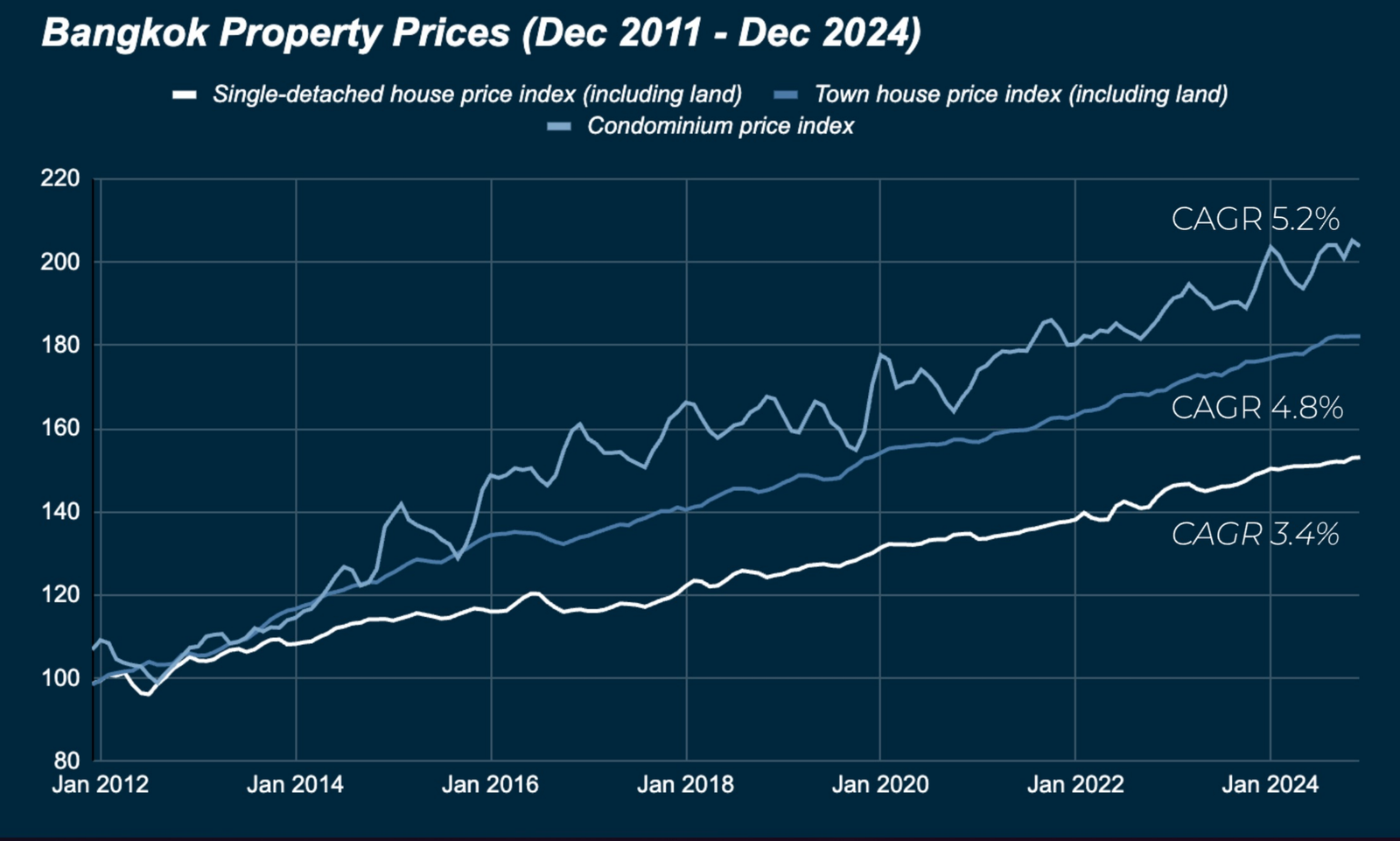
Source: Bank of Thailand price indices · Dec 2011 – Dec 2024
Are “guaranteed yield” offers real?
Treat them with caution rather than dismiss them. Some guarantees are legitimate; with others the developer has effectively baked the return into a higher price, or the guarantee quietly ends after the first couple of years. The most useful question is: what would this unit actually rent for without the guarantee? Always do your own due diligence on the developer and the underlying rent.
What taxes apply when buying or owning?
They're relatively light: about a 1% transfer fee (often shared with the developer), a 3.3% specific business tax only if you sell within 5 years (0.5% stamp duty after that), and a small annual property tax. Always confirm the current specifics with a Thai advisor.
What are the all-in costs beyond the sticker price?
Budget for the transfer fee, a one-time sinking-fund contribution, the first year's common-area fee, and (if you use one) legal fees. Furniture may be included or a small add-on depending on the project. We give you the all-in number up front so there are no surprises.
Is my rental income taxed?
Rental income earned in Thailand is taxable, and if you spend 180+ days a year in Thailand you're a tax resident. A standard expense deduction is available. It's modest for most owners, but confirm your situation with a Thai accountant.
What are the common fee and sinking fund?
The common fee is a monthly per-square-metre charge that runs the building, security, cleaning, pool, gym and management. The sinking fund is a one-time contribution at purchase toward major future repairs. Both are normal and should be factored into your net yield.
What does it cost to sell, and is there capital gains tax?
Thailand has no separate developed-market capital-gains tax. On sale you'll typically pay the transfer fee, the specific business tax (3.3% if sold within 5 years) or stamp duty (0.5% after), and a withholding tax. The withholding tax is an income-tax component computed on the property's government-appraised value, with a deduction that grows the longer you've owned, so the effective bite is usually a low single-digit percentage. Have a Thai tax advisor estimate your exact exit costs.
Off-plan vs ready, what's the difference?
Settle this first. Off-plan (under construction) usually means a lower entry, staged payments and early-buyer pricing, but you wait and carry completion risk. Ready (completed) means you can see the actual unit, rent it out immediately and have more certainty, but you pay more of the price upfront. The right choice depends on your timeline and risk appetite.
What's the overall buying process for a foreigner?
Reserve the unit with a booking fee, sign the sale-and-purchase agreement, remit your funds from abroad in foreign currency to obtain the FET, then register the transfer at the Land Department. The payment timing differs for off-plan vs completed units, see below.
How do payments work for an off-plan unit?
Typically an upfront booking fee, then an initial down payment of around 10-15%, then little to nothing until the project completes, with the balance paid on completion and transfer. Your cash goes in gradually over the build period.
How do payments work for a completed (ready) unit?
Usually a booking fee first, then a down payment of around 30% a week or two later, then the remaining ~70% about a month or so after that, when the title transfers to you. It moves much faster than off-plan because there's no construction to wait for.
Can foreigners get a mortgage in Thailand?
Usually not, Thai banks rarely lend to non-resident foreigners because you can't show Thai income. If you do have proof of Thai income, a local bank loan can be possible. In practice most foreign buyers complete without financing, using their own funds; with off-plan, the developer's staged schedule spreads the payments out.
How do I transfer the money in?
You wire funds from your own overseas account into Thailand in a foreign currency, not baht. The receiving Thai bank converts it and issues the FET certificate. It's usually just one or a few transfers, and the remitter's name must match the buyer's.
What is the FET form and why do I need it?
The Foreign Exchange Transaction form is the bank's proof that you brought money in from abroad in foreign currency. You need it to register freehold foreign ownership at the Land Department, and again to repatriate your funds cleanly when you sell.
Why are some projects so much cheaper than others?
Usually because they're optimised for practical value rather than show. The cheaper projects put the money into the unit, not a grand air-conditioned lobby, elaborate landscaping or resort-style facilities, so the price looks surprisingly low, but it's a real, no-frills freehold unit with proper title. It's not too good to be true, it's a different spec. Nara's happy to walk you through a specific unit so you can see exactly what you're getting.
How do I know an off-plan developer will actually finish?
Developer track record is everything off-plan, which is why we weight it heavily and will flag a shaky developer plainly. Look at their delivery history, financial backing and whether earlier phases completed on time. For nervous buyers, a completed, ready unit removes this risk entirely.
Do I need a lawyer?
For a new launch, contracts are fairly standardised and developers generally won't amend their terms, so a lawyer is mainly there to help you understand the legal risk rather than renegotiate. For resale units a lawyer is more strongly recommended, that's where they earn their fee, checking the title, the foreign quota, any outstanding fees and the building's juristic accounts. Tenara can introduce an independent lawyer; we don't force it.
Are the units furnished?
It depends on the project, some come fully furnished, some include a furniture package as a small add-on, and some are bare. We tell you exactly what's included for any unit you're considering, so the price is like-for-like.
Can I live in the condo myself?
Yes, a freehold condo is yours to occupy, rent out, or both. Many buyers split the difference, using it on visits and renting it the rest of the year.
Can I rent it out short-term or on Airbnb?
Long-term renting (monthly leases) is straightforward. True short-term daily rentals are restricted under Thailand's Hotel Act and most condo buildings prohibit them, so don't bank on nightly Airbnb income. If short-stay matters to you, we'll point you to the few buildings set up for it.
Who manages the rental while I'm overseas?
Property managers and rental-management services handle tenant-finding, rent collection and upkeep for a fee, and some developers offer it in-house. Tenara connects you with vetted managers so you're not running it from abroad yourself.
Does buying property give me a visa or residency?
Not residency or citizenship, but there is now a long-stay route tied to property: a 3 million baht qualifying investment (purchase, long lease, or rental) recently introduced under the Thailand Long-Stay scheme gives renewable one-year permission to stay, with no work rights or permanent residency. The rules are new and still evolving, and there is political debate around the scheme, so if a visa is a major reason you're buying, speak to us early so we can check the current position before you commit.
Which areas should a foreign buyer focus on?
It depends on your goal: prime Sukhumvit and Sathorn for prestige and liquidity (lower yield), the city-fringe and east-Sukhumvit transit corridors for the best balance of yield and value, and emerging transit pockets for entry price. The constant rule is proximity to a working BTS or MRT station, demand stays deep there.
How is Tenara different from a normal property agent?
A typical agent can only show you what they hold, and is steered by which deal pays the most. Tenara isn't tied to any single developer's stock, so Nara reasons across close to 100 new launches to find what actually fits you, with the team's decade of market experience built in.
Is Nara biased toward certain projects?
No. Nara's job is to fit the right unit to your goal, not to push inventory, and it will tell you plainly when something isn't right for you or when an area is oversupplied. Honesty about the downside is the whole point.
Can I talk to a real person?
Yes. Nara is the fast, always-on first step, and when you're ready the Tenara team and vetted partners (lawyers, developers, property managers) take over for viewings, confirmations and closing. You get the speed of AI and the backing of real operators.


